All in a Day's Walk
A month-long slow food walking performanceArchive for Home
Winter solstice

It’s the winter solstice which is the event I now choose to celebrate – with food, conviviality, warmth, gifts – as my mid-winter festival of choice. (Not that I’m completely bah humbug about the big C – I’m even walking to Putley for carol singing tonight.) All in a Day’s Walk has thrown this into an even sharper focus this year – the presence of daylight (or not) has been very much present for me in my daily life in walking and even eating. Eggs – my precious only source of local protein – have been harder to come by, because the shorter days are also the reason why the hens on the farm are laying less. (A connection I hadn’t considered before.)
I’m not a very conscientious celebrant, but it feels important to mark this turning point – the ‘standing still of the sun’ – as I’m walking underneath it.
‘The great cosmic wheel of the year… the symbolic wheel of time is acknowledged here. Jul or Yule means wheel in Norwegian. Northern Europeans of our Celtic past believed this mystic wheel stopped briefly at this crucial point as one cycle ended and a new cycle of the sun began. It was taboo to rotate any wheels at the Winter Solstice, from cartwheels to butterchurns, as they waited for the return of the sun.
Evergreens are brought into the home at this time to represent everlasting life…Each of the evergreens has a deeper symbolism. Red holly berries represent the red female blood of life while the white mistletoe berries represent the the white semen drops of the life-giving male
There is an old tradition of making wheels of evergreens as we celebrate the wheel of the year turning once again towards the sun… ‘
Glennie Kindred (2001) Sacred Celebrations Glastonbury: Gothic Image
Over the past few days, my walking has allowed me to collect various evergreens and I make a solstice wheel from plaited ivy (Fownhope church wall, to be mildly subversive), holly (How Caple and Capler Camp – the iron-age hill fort above the farm), yew (Capler Camp) and mistletoe (Oldstone Farm orchard). I also make my first truly successful rye-spelt sourdough bread – coincidentally shaped into a wheel/ring so that it can cook more easily in my stove-top oven improvised from a cast iron casserole dish.


Solar and salad


Today I’ve arranged to talk to Chris from Caplor Energy – the renewables ‘wing’ of the farm business here where I live. They specialise in solar photovoltaics and solar hot water systems. As a renewables geek, I’m inordinately proud of living here, where pretty much every large south-facing roof is covered in panels and the water in our shower block and livery yard is solar-heated (even Merlin is a fan). And we have a 15kW Proven wind turbine. In terms of energy for this project, all my space-heating, water-heating, and cooking is being supplied by my wood burner, fuelled with local wood. But I’ve also ‘allowed’ myself electricity – for light and computer only – on the basis of all this local renewable generation, the largest array on the barn just above my head as I type. It’s not a closed-loop off-grid system at Caplor, but I’m curious to ask, if it were, how much energy of the farm business and community’s energy needs would be met by the renewable installations. Chris gives me a tour and answers my questions and I’m particularly interested to learn that it’s winter food storage (potatoes) that takes a considerable amount of the farm’s winter energy use. The edited highlights of our conversation are here (with the interesting noises-off of two of the farm blacksmiths working in their nearby forge!)…


Later I walk to the village to catch the last post and stock up on local apple juice, the sun already setting. As I cut across the rec ground, they’re cutting the grass and I’m trying to work out why it’s making me hungry. Then I realise the smell of the grass is making me craving the juicy greenness of summer salad…


Fownhope Farm Shop

The Fownhope Farm Shop has been my mainstay and local food hub since the start of this project. Conveniently located almost literally on my doorstep, there has been a farm shop selling local produce at Caplor for the past 6 years or so. Originally this was the farm’s own initiative with all the produce grown on the farm itself, supplying not only the shop but also local schools and restaurants. It then went through various iterations – including a local food and crafts shop staffed by farm residents – before being taken over this year by Dave and Elise Shuker. They now manage the polytunnel on the farm and also keep pigs and hens here, but they stock a range of produce from surrounding local food suppliers. Sourcing all the food locally is at the centre of their ethos, knowing exactly where and who it’s come from: their own eggs, honey from Brockhampton, apple juice from Carey Organics, their own veg (in season) supplemented by a range of vegetables from Aconbury, Allensmore, Bartestree, Holme Lacy and Stoke Edith. Before going for a walk with my friend Sue who is staying, I visit the shop today. I ask Dave to draw on my map the exact locations of the places where all the vegetables I’ve purchased so far have come from, so I can plan my walks there accordingly and maybe contact the producers. Below is an edited recording of one of our many conversations as I shop…
Audio Track: Fownhope Farm Shop


I do not know how to make moisturiser from a nettle…
Being hyper-aware of where my food (and energy) is coming from, I’m suddenly hyper-aware of the ‘away-from-here’ ness of all the things I use and need: the ‘consumables’ that I consider essential (to varying degrees) or at least have become accustomed to being able to use whenever I choose. I make a substantial list even from the first things I’ve used within an hour of waking that day:
Toilet paper (recycled, natch)
Toothpaste (Kingfisher, of course)
Toothbrush (Monte Bianco, saving the planet one toothbrush stalk at a time)
Shower soap (Weleda)
Deodorant (Weleda)
Toilet cleaner (Bio-D)
Surface cleaner (Earth Friendly Products)
Sponge (alas, from evil supermarket)
Board chalk (village shop)
Moisturiser (Burts Bees)
Matches
Baking parchment (If You Care, FSC-certified – REALLY)
It’s worrying that, even through the frisson of eco-smugness that could be attached to the ‘ethical consumer’ brand names (=fewer chemicals, minimalist packaging, biodegradable, hand-made by free-range unicorns on a guaranteed minimum wage etc.), there is still so much s t u f f here…
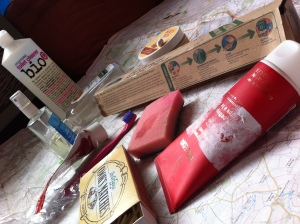
And then there are all the containers – glass, plastic, film, cardboard – they are squashed, poured or rolled into and around. In all their colourful (yet also, of course, tastefully restrained) plumage, they form a textured map of the complexity of our dependence on t h i n g s: products that I – for all my supposed knowledge about ‘eco-living’ – would have little idea how to make myself or replicate the effects of using only locally available herbs or chemicals. (A sudden pang of eco-inadequacy: I do not know how to make moisturiser from a nettle.) And our dependence on oil to package, transport and store them.
Through my focus on local food and my physical, pedestrian relationship to fetching it, I am suddenly acutely aware of all that is coming in to my home and all that is going out and the physical journey it made to reach here. And thinking like this, even my own home – a static caravan at present – feels suddenly alien, other, with no relationship to me, my making or the materials available in the local environment. It’s as if we’re all caddis flies from a littered river, surrounded by a constructed carapace of compulsively-collected detritus that is not of our making… I mourn suddenly my recently-taken-down-for-repair yurt – with its wooden frame (trellis walls (khana) and roof poles) made from a Herefordshire oak felled by the maker himself. I had never before considered the ‘home miles’ of the shelters we choose to live in.
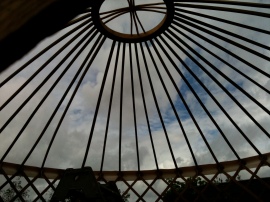
Impractical as it would be (for me and the rest of humanity) I can suddenly understand the urge to live in a bender in the hills…
Sabbath
I’m going with a Friday sabbath today. No walk, just domestics which are time-consuming enough. But I do start to toy with the idea of making a map of the produce I’m using… I have an idea I want to do this in a studio space with a map of Fownhope projected vast on to the floor, the routes I’ve tramped to each food seller/source progressively filled in with produce or its peelings over the course of the day’s installation as the sound track of the people I interview plays continuously… a map of local food emerges as the OS base is progressively filled.

I start fantasising about using lentils for orange B roads like a Carl Warner foodscape. Shame they’re not local. But what a waste that would be…
SLOW

In the caravan, my water is frozen today. (Picture’s from two years ago, but you get the idea.) Even though this only means walking to the very nearby showerblock to fill up buckets, bottles and kettle, I don’t have the mental capacity or calories to deal with this. I don’t walk today, any further than around the fields to break the ice on the three water troughs for the horses. Rough Patch – Banky Field – Rough Patch – Tacklizer – Rough Patch.
Cold, I am slowed down in every sense.
I expend my energy instead on the domestic: making bread, refreshing leaven, fetching and heating water, washing up, fetching wood, sweeping. It takes all my energy. I make a stew and feel better.
My s l o w n e s s makes me think how much I’ve read the term ‘slow’ in various contexts in recent times.
Slow food ‘a global, grassroots organisation with supporters in 150 countries around the world that links the pleasure of food with a commitment to the community and the environment. We work to reconnect people with where their food comes from and how it is produced so they can understand the implications of the choices they make about the food they put on their plates. We encourage people to choose nutritious food, from sustainable, local sources which tastes great.’
Slow pedagogy from Phillip Payne and Brian Whattchow (2008) ‘Slow Pedagogy and Placing Environmental Education in Post-Traditional Outdoor Education’ Australian Journal of Outdoor Education 12 (1): 25-38 ‘Time, and our experiences of it, warrants attention in ‘place’ pedagogies in outdoor education. Place typically involves the experience of a geographical location, a locale for interacting socially and/or with nature, and the subjective meanings we attach over time to the experience. Place, however, cannot be severed from the concept and practice of time, as seems to be occurring in the discourse of outdoor education. The way outdoor educators carefully conceive of, plan for, manage and pedagogically practice time may, in our view, positively facilitate an introductory ‘sense’ of place. We illustrate the under-theorised relationship of time and place in outdoor and experiential education via a case study of a semester-long undergraduate unit, Experiencing the Australian Landscape. It reflexively describes how two post-traditional outdoor educators working in the higher education sector have assisted pre-service experiential and outdoor educators to sense, explore, conceptualise and examine how ‘slow’ time is important in ‘placing’ education in nature.‘
Slow activism from Wallace Heim’s beautiful chapter ‘Slow Activism: Homelands, Love and the Lightbulb’ in B. Szerszynski, W. Heim and C. Waterton (eds.) (2003) Nature Performed: Environment, Culture and Performance Oxford: Blackwell 183-202
Slow = good Slow = better Slow = the answer?
Mumpets and miracles
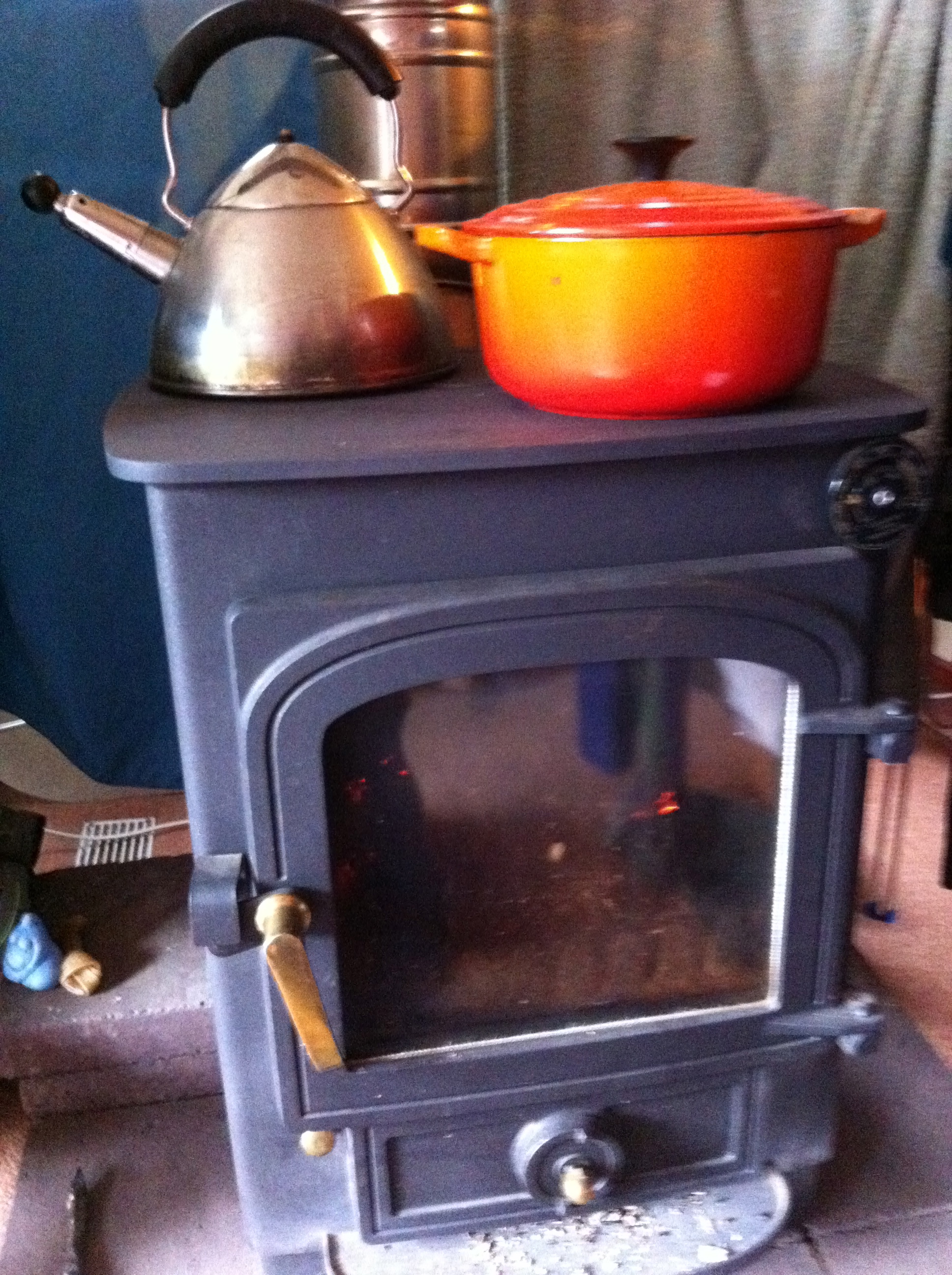
It’s the sabbath, and so (going with the environmentalism-as-religion theme that seems to be emerging) I rest.
But a friend is visiting and I want to be hospitable – a strange conundrum for an environmentalist at the best of times when the desire to produce generously large quantities of food for guests is set against the idea of preventing waste and avoiding excess. Inexplicably, I’m still struggling to understand how to feed myself properly and palatably let alone anyone else. Inexplicably because, while I’m picking up delicious vegetables from the farm shop, they alone don’t seem to be giving me enough energy or texture or flavour – especially in the absence of herbs and spices, salt, pepper and anything else that is not strictly local. Yesterday, Woolhope baker and miller Gail Sayce gave me some of her rye sourdough leaven. I refreshed it when I got home (100 ml of water at room temperature, 100 g of rye flour) and will again today, but it won’t be ready to use to bake leavened bread until tomorrow.
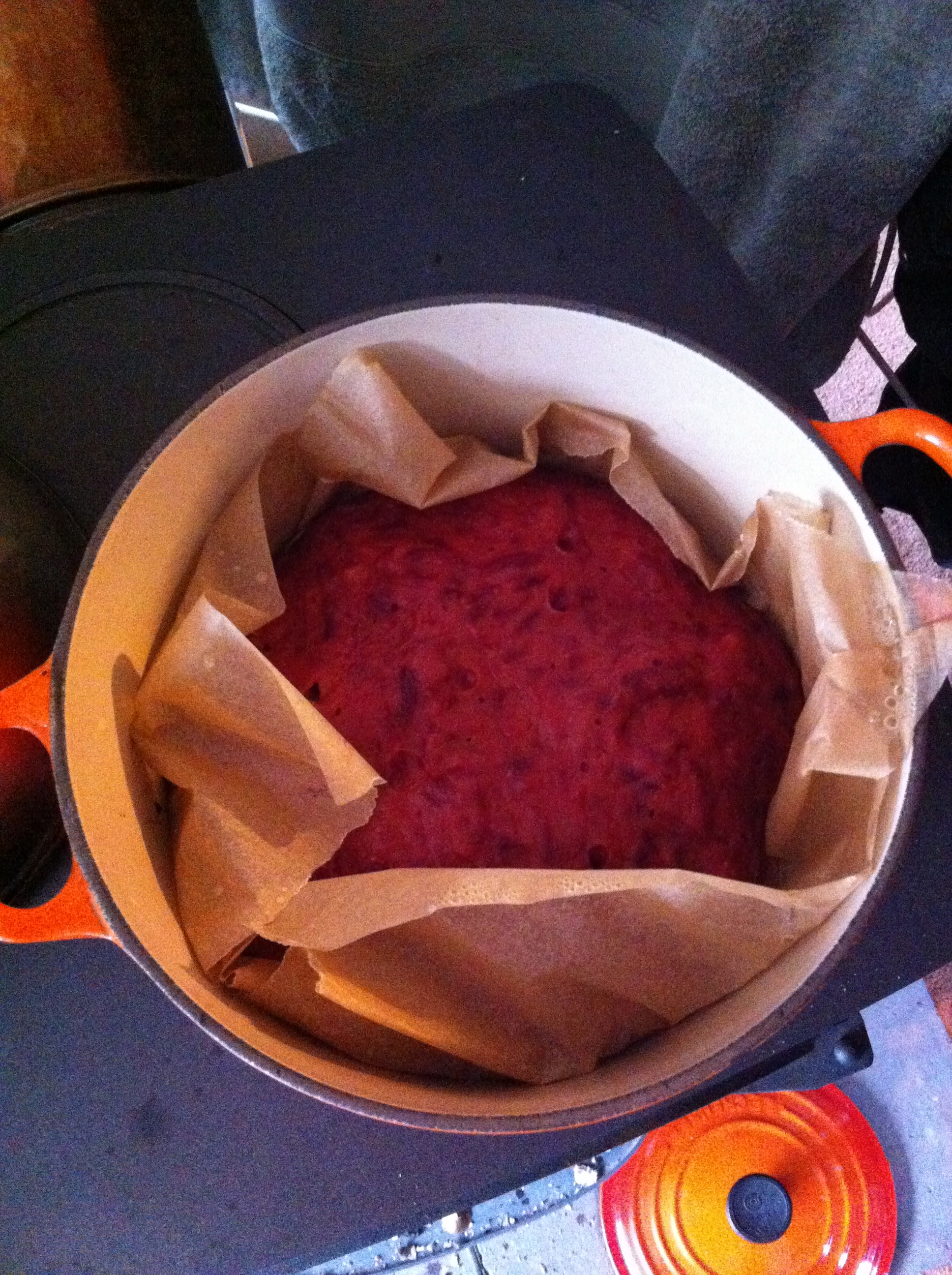
I settle on a menu of root stew with rye/spelt flatbreads followed by an improvised attempt at fatless beetroot cake (fatless because I’m allergic to dairy and while oilseed rape is grown on the farm, it is pressed and processed elsewhere; beetroot because it’s sweet and pretty).
My friend arrives when I’m midway through making (up) the beetroot cake, beating in eggs to the mixture. Already, my tastebuds are grateful for the slightest flavour, colour, texture, calories: the sweetness of raw carrot, the richness of egg yolk. I say I’m reminded of one of my favourite lines in a book (Judy Budnitz (2000) If I Told You Once) ever and I get it off the shelf to read, realising it has more resonance to my current situation than I’d realised:
‘My family had lived in the same village for as long as anyone could remember. It was a place that lay buried in snow for nine months out of the year followed by three months of mud. It was the most desolate spot on earth and my family did not even realise it, because for generations they never ventured more than 40 km from the place. They were stubborn people.
It was a place where someone had forgotten to add the colour: low grey clouds, crooked houses of weather-beaten wood, coils of smoke rising up from cookstoves and rubbish heaps. All the wives of the village cut from the same dull cloth to make clothes for their familites. We ate grey bread. The men made a fermented liquor so colourless it was invisible, nothing but a raging headache stoppered in a jar.
People were simpler then. They kept their desires within reach. They had few possessions: a goat, a half-dozen chickens, a brass teapot, a cat so ugly it could kill mice merely by looking at them.
That was enough. After days cutting wood in the black forest with ice clogging their nostrils, the smell of a goat was a welcome thing.
In a place like that, the colour of an egg yolk was something of a miracle’
We go out for a walk anyway, but I ride Merlin. Cantering up the track back home, I realise this is the fastest I will travel this month. And suddenly the speed of a horse is a miracle too.
We return and eat more woodburner beetroot cake, agreeing that the texture is a cross between a muffin and a crumpet. We have, my friend triumphantly proclaims, invented m u m p e t s.
Mumpets
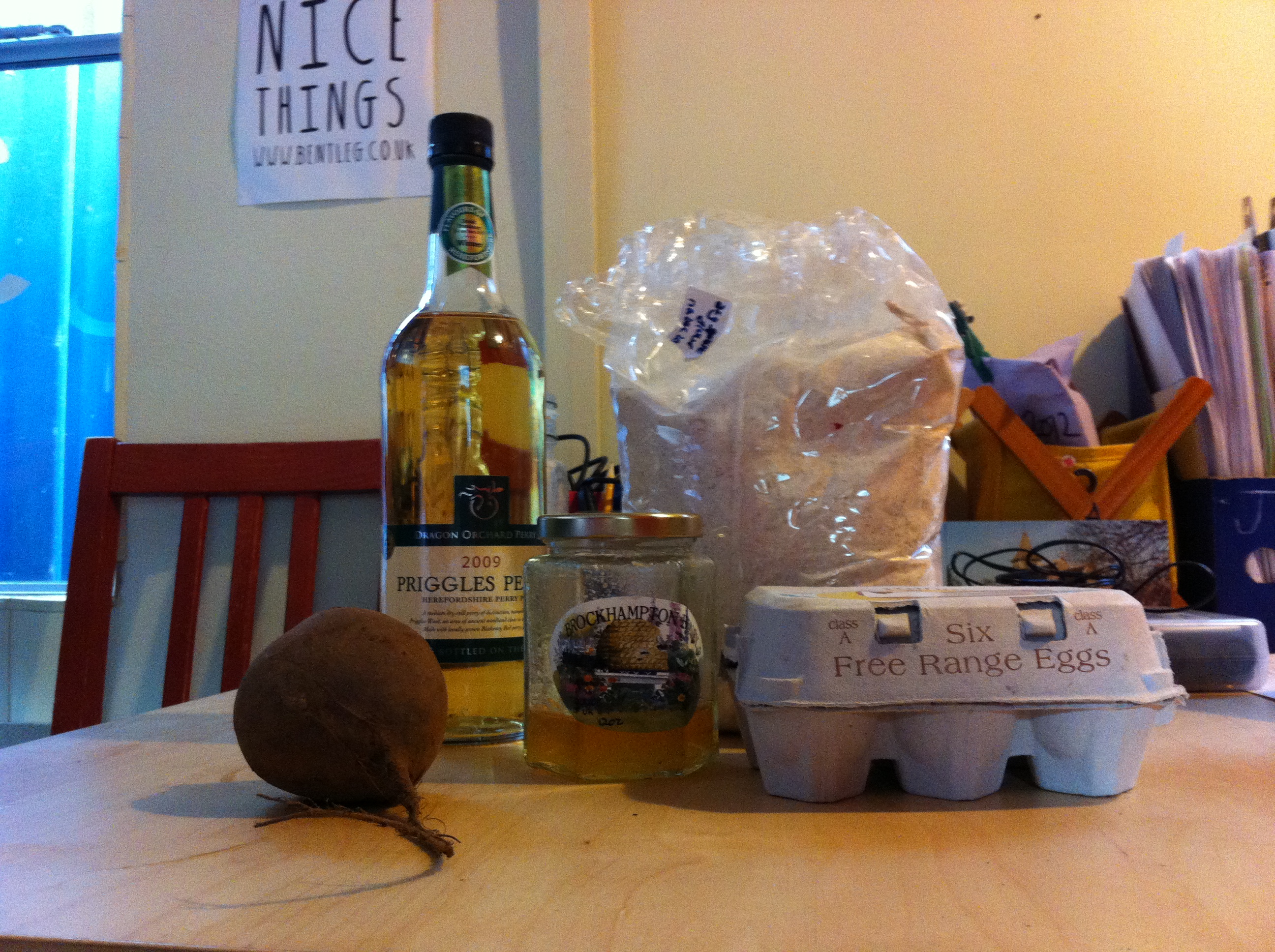
Ingredients
1 medium beetroot (Merrivale Farm, Aconbury (via Caplor Farm shop): 7.5 miles)
2 large eggs (Caplor Farm: 0.01 miles)
2-3 tablespoons honey (Dockhill Well, Brockhampton: 0.79 miles)
dash of cider/perry (Dragon Orchard, Putley: 6.53 miles)
spelt flour to create correct cake mixture type consistency (grain from Doves Farm, Hungerford 73.6 miles yikes, but milled at Yare Farm, 1.9 miles)
Equipment
Wood burner
Cast iron lidded cooking pot or Dutch oven, lined with baking parchment
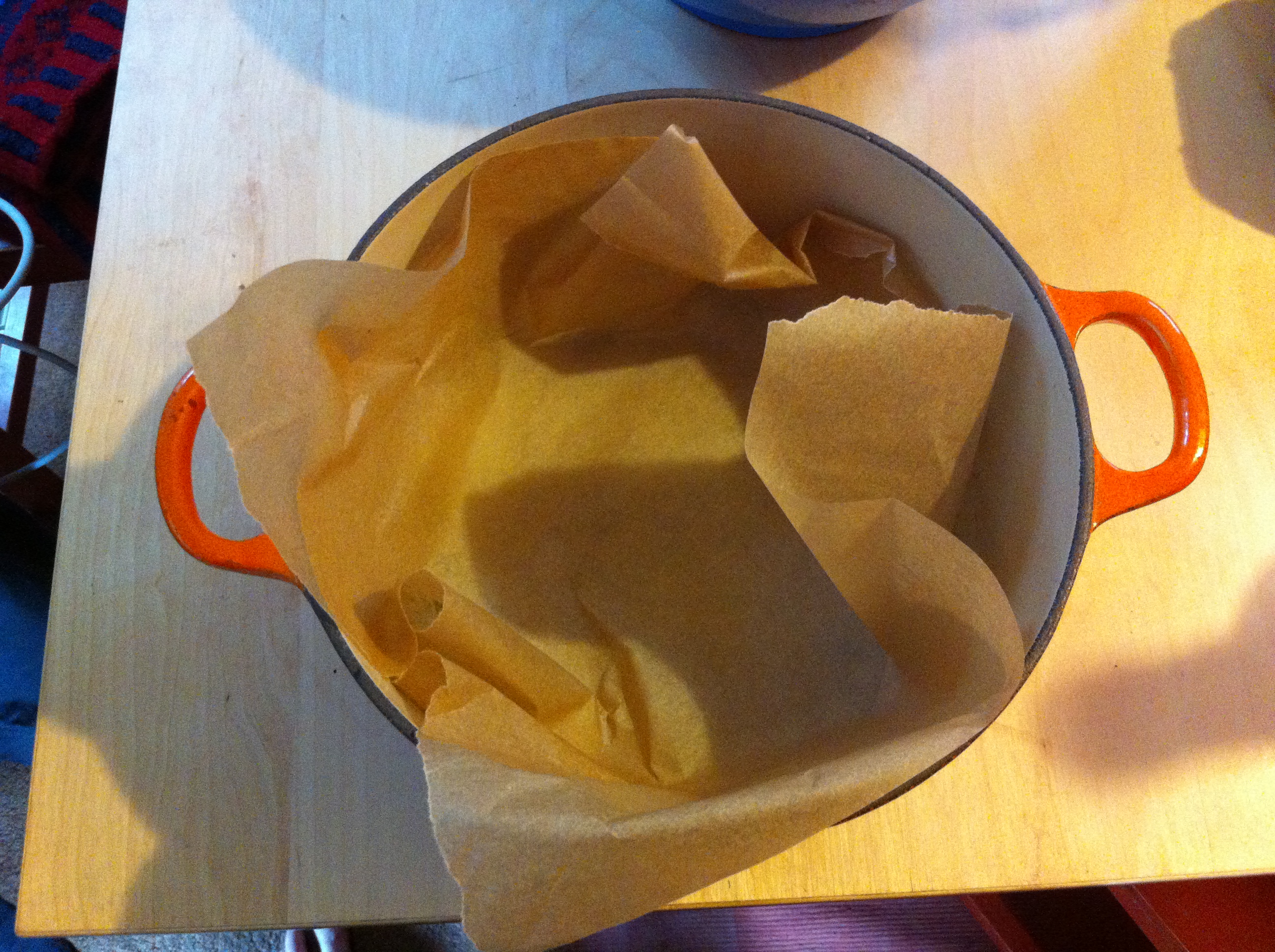
Method
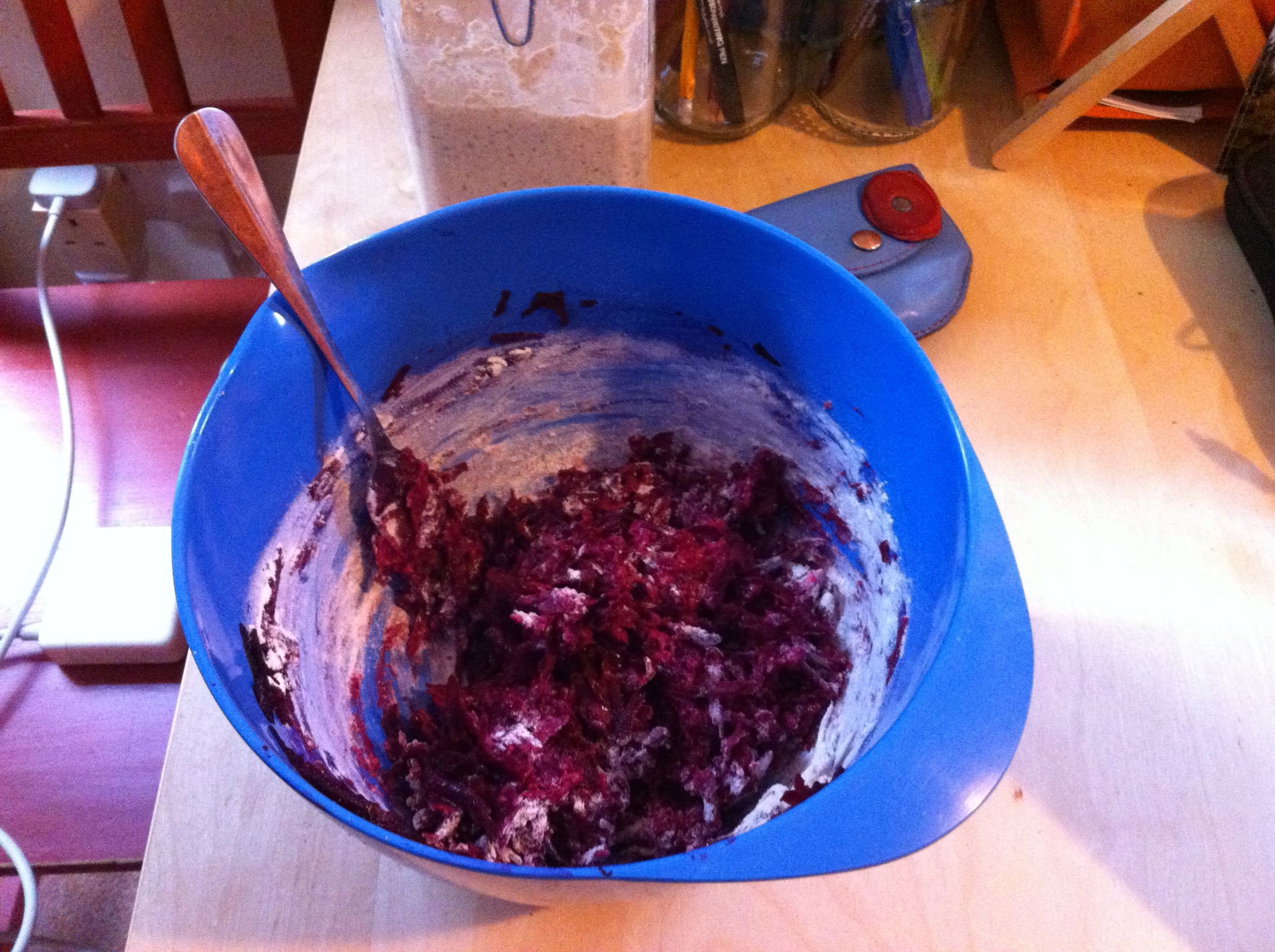
1. Peel and grate the beetroot (save the peelings for your eats-anything horse or compost bin)
2. Add eggs and honey and a dash (to taste) of cider; mix well
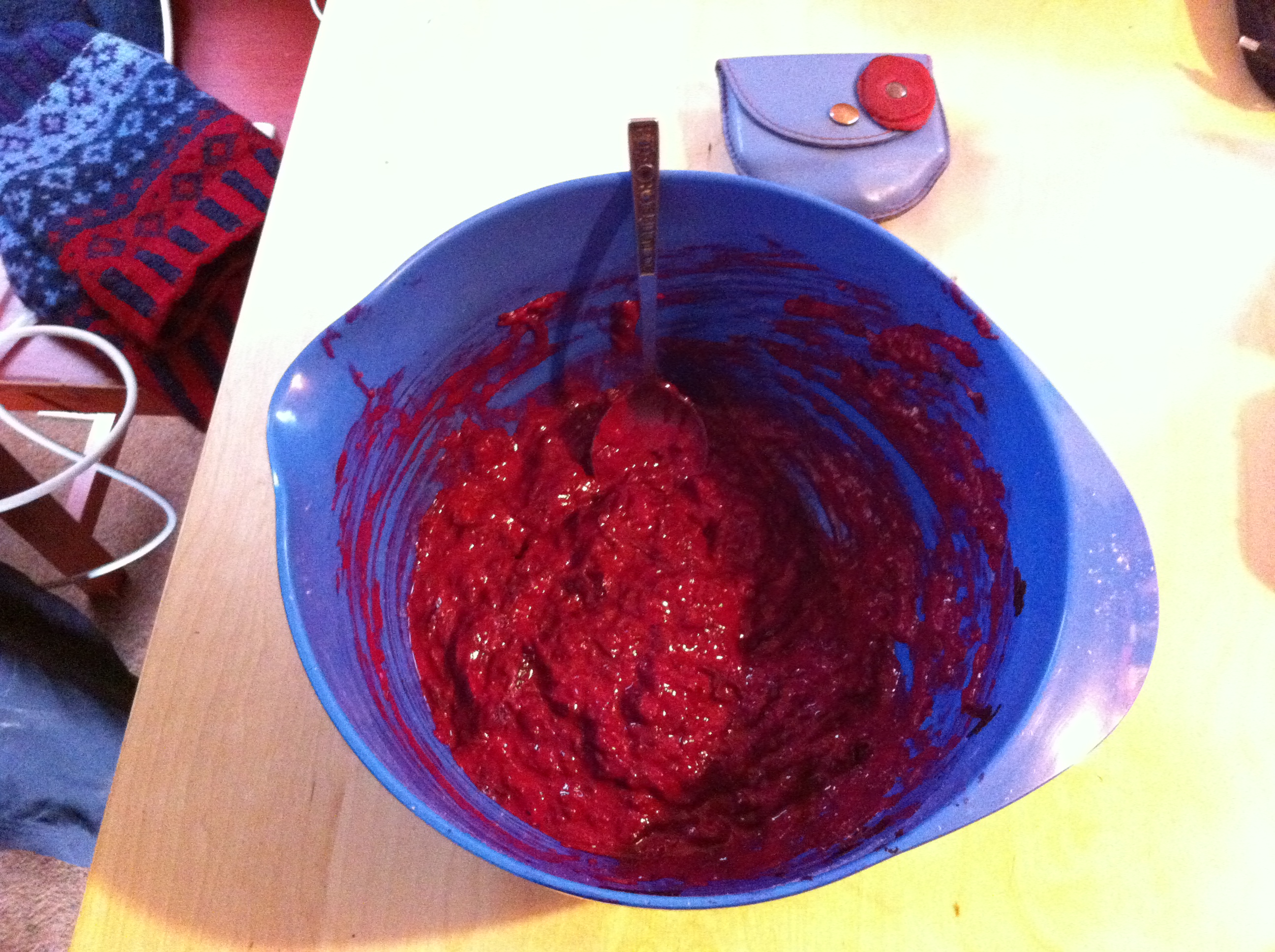
3. Add enough spelt flour to create a correct cake-mixture type consistency; mix well again
4. Marvel at the beautiful colour
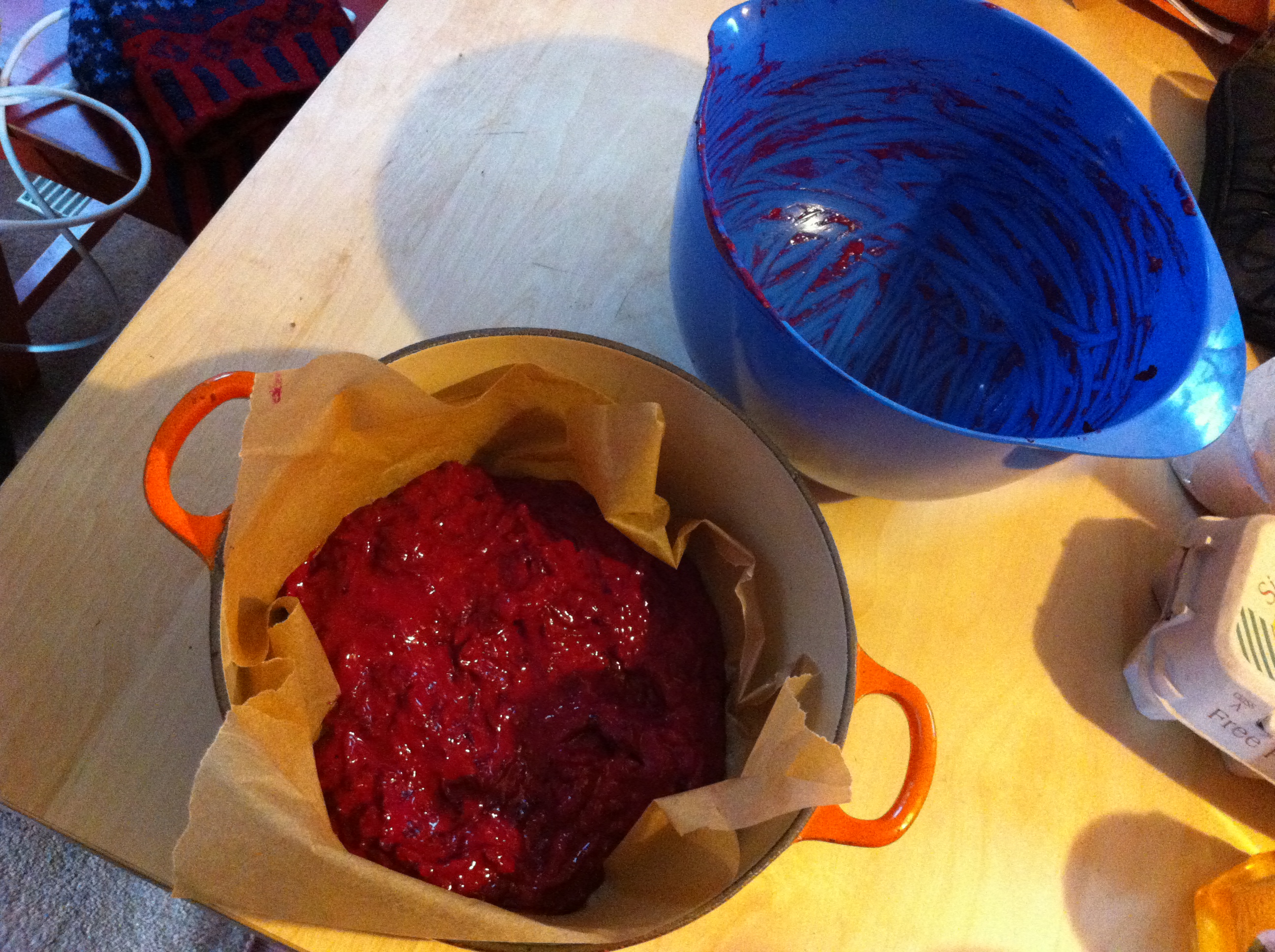
5. Pour into lined pot, add lid and place on top of woodburner at medium-high heat
6. Leave there for at least 20-30 mins or until you smell cooking/slight burning – DO NOT LIFT THE LID BEFORE THEN or all the heat escapes.
7. Your mumpet is ready when the base is not-quite-burned and the top is no longer sticky.
8. Marvel again at your stove-top ingenuity…


 All in a Day's Walk